
Eyewash Station Selection: Match to Site Conditions
Eyewash Station Selection: Match to Site Conditions
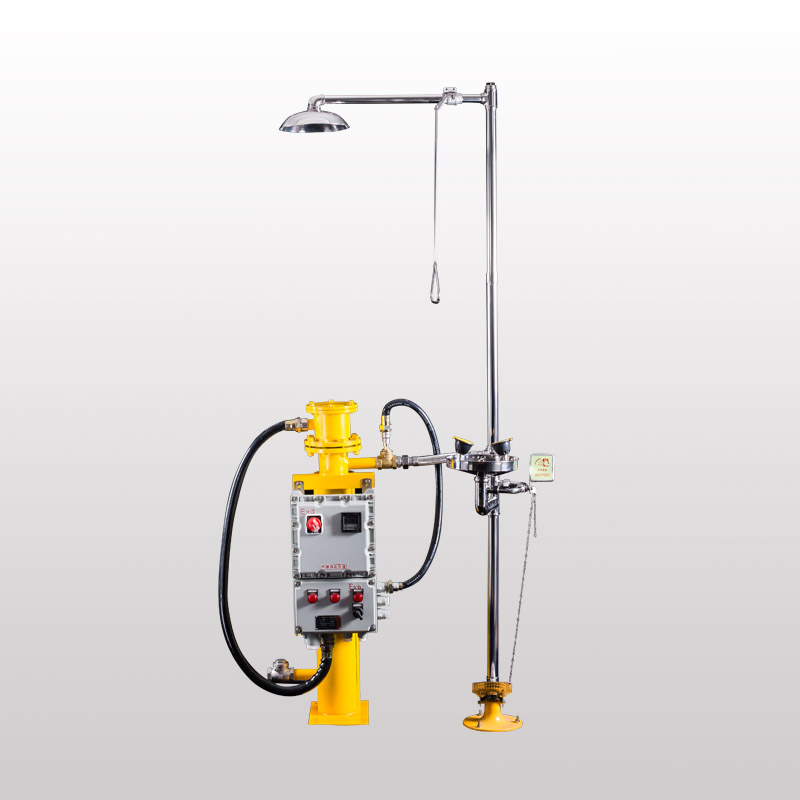
The right emergency eyewash station cannot be chosen from a catalogue alone. Site conditions determine whether the equipment must resist freezing, withstand corrosive chemicals, operate in an explosive atmosphere, fit on a laboratory bench, or supply its own water. This guide helps procurement and safety teams map project conditions to the BOHUA eyewash station range during the Research and Evaluation phase.
In this guide, BOHUA refers to Shanghai Bohua Safety Device Co., Ltd., a China-based manufacturer founded in 2006 that specializes in the development, production and sale of emergency eyewash and shower equipment. It operates from Songjiang District, Shanghai, and its product family includes wall-mounted, desktop, vertical, portable, anti-freeze, electric heat tracing, electric heating and combination emergency shower and eyewash units.
Why a Standard Eyewash Station Configuration Is Not Enough
An eyewash station that is correct for a warm, indoor laboratory can fail before it is used in an outdoor chemical plant. A water-piped unit cannot protect someone at a remote temporary work site if no plumbing exists. A standard exposed pipe can freeze in winter if the installation point is outdoors and the unit has no freeze protection. Equipment near strong acids may suffer corrosion if the selected material is not suitable. The working conditions therefore need to be documented before a model is specified.
Typical project environments include chemical plants, pharmaceutical factories, laboratories, petrochemical facilities, battery manufacturing plants and university research labs. These sites may present high temperature, low temperature, corrosive atmosphere, dust, or normal indoor laboratory conditions. Buyers also need to decide whether the project is an EHS system, emergency response station, chemical safety retrofit, new plant construction or laboratory safety upgrade.
Industry Background and Compliance Context
Industrial demand for emergency shower and eyewash equipment remains broad. According to Spherical Insights, the global emergency shower and eyewash station market was valued at approximately USD 417.3 million in 2024. Transparency Market Research projects that the market could reach USD 713.4 million by 2035, growing at a CAGR of 4.7% from 2025. Third-party data from Dataintelo also estimates that industrial applications, including chemical and manufacturing, account for about 35.7% of global eyewash station revenue.
Compliance frameworks reinforce the need for formal product selection. The ANSI/ISEA Z358.1-2014 (R2020) standard requires eyewash stations to deliver 0.4 gallons per minute of flushing fluid for at least 15 minutes. The European EN 15154 series regulates emergency safety showers, and Part 2 specifically covers plumbed-in eyewash units. Product specifications and certificates should therefore be compared with the local project standard.
BOHUA Eyewash Station Options by Working Condition
BOHUA product documentation describes equipment for demanding sites. For example, the approved product statement says that the product operates under high-temperature and corrosive atmosphere conditions and is designed for low-temperature environments requiring freeze protection. In practical terms, the same unit may need to remain functional in an outdoor chemical facility during winter while also resisting the surrounding process atmosphere.
Cold-Climate and Freeze-Protection Scenarios
For sites with low winter temperatures, the specification should focus on freeze-protected equipment. BOHUA offers an anti-freeze and anti-scald vertical eyewash, model BH32-1008, and an anti-freeze and anti-scald shower and eyewash, model BH30-1008, both constructed from 304 stainless steel. The vertical unit has a DN32 water inlet, an eyewash height of 1050 mm, and listed eyewash flow of 12–18 L per minute. The combination-style anti-freeze unit adds shower flow of 120–180 L per minute and an eyewash flow rate of at least 1.5 L per minute.
In colder regions, electric heat tracing models provide more active freeze protection. The BOHUA electric heat tracing shower and eyewash model BH30-1062L uses a 220V power supply, 48W/M electric heat trace, and a shell made from ABS over 304 stainless steel. Its published protection levels include IP54, IP56 and IP65, and its explosion-proof grade covers EXD II BT4, BT6, CT4 and CT6. For very cold projects where active heating is required, BOHUA also lists electric heating models such as BH30-1066 with 380V input, 15KW heating power, IP65-rated protection and explosion-proof classification.
Corrosive and Explosion-Risk Process Areas
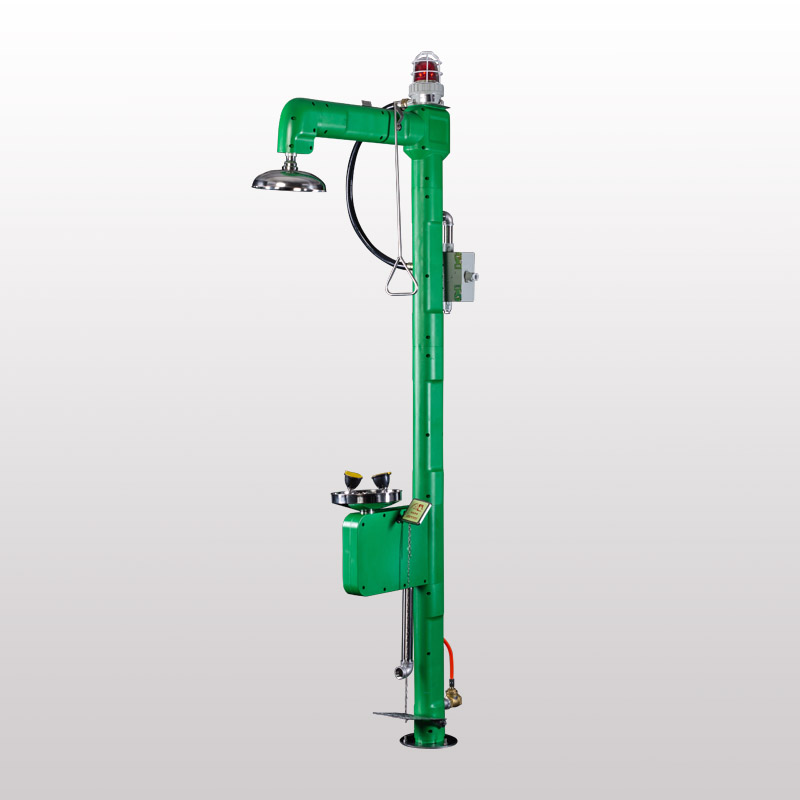
Facilities with acid, alkali or solvent exposure need not only the correct flushing flow but also materials that can survive the environment. Many BOHUA combination stations are available in 304 stainless steel with ABS parts, while the compound emergency shower and eyewash model BH30-1316 is specified in 316 stainless steel. The 316 stainless construction is typically selected for more severe chemical exposure, because the same shower and eyewash configuration provides overhead decontamination and eye flushing.
The explosion-proof ratings found on BOHUA electric heat tracing and electric heating units are relevant for hazardous areas. For example, electric heat tracing models list EXD II BT4, BT6, CT4 and CT6 explosion-proof grades, while electric heating models list EXD II BT4 and CT4. These specifications allow the project team to screen models against the site area classification before selecting the final station.
Indoor Laboratories and Clean Work Areas
For eye-only hazards at laboratory sinks and benches, BOHUA offers several compact configurations. The wall-mounted eyewash model BH33-1011 uses 304 stainless steel and ABS, has a DN32 inlet and outlet, and provides the required 101.6 mm sprinkler spacing with activation within one second. Where hands-free operation is preferred, the fully automatic wall-mounted eyewash model BH38-1010 provides the same inlet/outlet size and is made from 304 stainless steel.
Desktop or bench-mounted models are useful when a permanent floor station is not practical. BOHUA lists the BH35-1009 desktop unit in 304 stainless steel and another version, BH35-1011L, in green with a 304 stainless steel and ABS body. Desktop units are designed for workbenches with eye splash risk but no need for full-body showering.

Remote Sites Without Permanent Plumbing
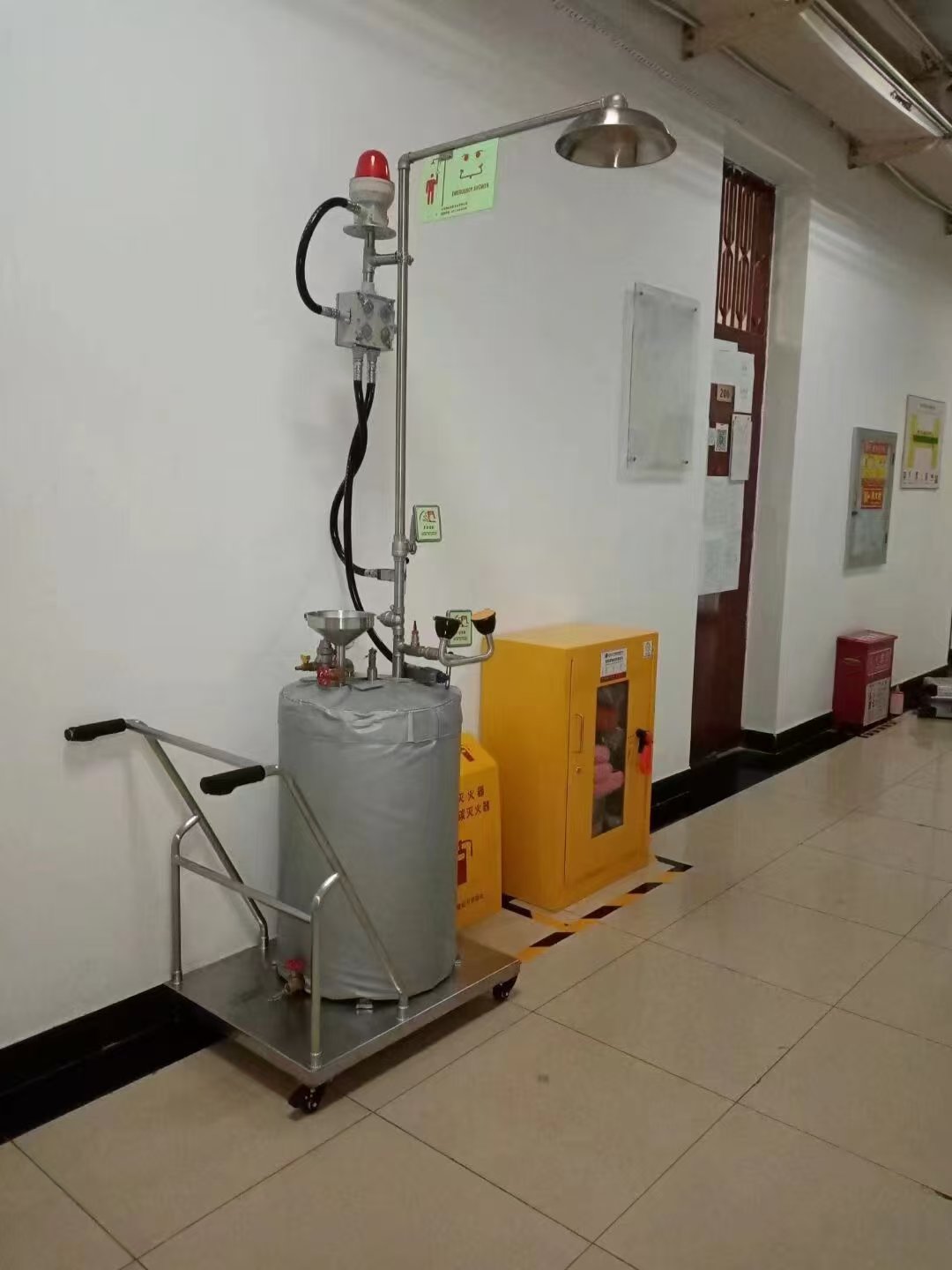
Portable shower and eyewash stations provide a solution when no piped water is available. BOHUA’s portable shower and eyewash model BH34-0628 includes a 28 L tank, while the model BH34-0665F is available with a 65 L tank. Both are floor-mounted 304 stainless steel units with a push handle, DN32 inlet/outlet connection, and a listed tank pressure of 1.0 MPa. The portable configuration is important for temporary plants, outdoor maintenance zones, and sites where construction must begin before plumbing is completed.
Combination Shower and Eyewash Stations for Full-Body Hazards
When a chemical spill can affect the eyes and the body at the same time, a combination shower and eyewash station is normally the more appropriate emergency response point. BOHUA compound emergency shower and eyewash models, such as BH30-1011, BH30-2011 and BH30-1011L, are floor-mounted and combine an overhead shower with an eyewash bowl. The published parameters include shower flow of 120–180 L/min, eyewash flow of at least 1.5 L/min, a shower head height of 2100 mm, and an eyewash outlet height of 1050 mm.
OEM/ODM and Site-Specific Engineering Support
Some projects require features that are not part of every standard model. BOHUA supports OEM/ODM production and lists customizable features such as acoustic and optical alarms, lighting, upload of DCS signals, electrical heating, cooling and skid-mounted systems. For such projects, the company states a monthly capacity of 1,000 units, a lead time of 30 days, a minimum order quantity of 5 units, and 100% testing before shipment. After-sales support is remote, which helps international buyers review installation and operation questions during commissioning.
Step-by-Step Eyewash Station Selection Process
The following process can help buyers convert a project scenario into a concrete model choice.
- Define the hazard type. Determine whether the emergency risk is eye-only or eye and full-body exposure. Review the chemical risk and the physical location of the hazard.
- Check water supply. Establish whether potable or process water is available at the point of use. If permanent plumbing is not available, evaluate portable tank-fed models such as BH34-0628 or BH34-0665F.
- Assess ambient temperature. Verify the minimum winter temperature and whether the station will be indoors or outdoors. Low-temperature environments require anti-freeze, electric heat tracing or electric heating configurations.
- Identify corrosive or classified areas. Check if the site has a corrosive atmosphere, dust, or an explosive area classification. Select 304 or 316 stainless steel and, when required, models with IP54, IP56 or IP65 protection ratings and the applicable explosion-proof grade.
- Define available space and mounting. Decide between a wall-mounted, desktop or floor-mounted unit. Laboratory corridors may suit a wall-mounted model; workbenches may require a desktop unit; open process plants normally need floor-mounted stations.
- Validate performance and user access. Compare eyewash flow rates, shower flow rates, spray head heights, sprinkler spacing, drainage height and activation speed. BOHUA product specifications for many models state a start speed within one second.
- Confirm supplier and project support. Review certification records, testing procedures, OEM/ODM capability, lead time, MOQ and after-sales support before finalizing the specification.
Use Cases: Applying the Selection Logic
Cold-Climate Chemical Facility
One documented ODM project involved 15 BOHUA BH30-1062 electric heat tracing shower and eyewash units for a cold-climate industrial facility. The project continued over a five-year period. According to the project record, the objective was to keep the facility legally compliant year-round and demonstrate due diligence for worker safety in cold climates. The recorded result is described as reliable, compliant and safe emergency response. This case illustrates the value of choosing a freeze-protected main unit instead of a standard outdoor station.
Laboratory Corridor with Eye-Only Risk
A university or analytical laboratory may place several wall-mounted eyewash stations at corridor locations near benches where researchers handle corrosive reagents. In that scenario, the BH33-1011 wall-mounted unit or the BH38-1010 fully automatic wall-mounted unit can match the need for eye flushing without requiring a full overhead shower. The compact footprint and simple DN32 connection are well suited to indoor retrofits.
Remote or Temporary Work Location
A construction site, outdoor maintenance job, or emergency response setup that lacks piped water needs a self-contained unit. The portable shower and eyewash models BH34-0628 and BH34-0665F provide tank capacities of 28 L and 65 L respectively, with floor-mounted operation and push-handle activation. This type of station can be positioned close to the temporary exposure area and later removed when the project ends.
Chemical Process Area with Full-Body Splash Risk
A plant that stores or transfers acid may have risk of splashes to both the eyes and body. In this use case, a combination shower and eyewash unit is usually recommended so that the worker can first rinse the eyes and then move under the overhead shower. Models such as BH30-1011 in 304 stainless steel and ABS, or BH30-1316 in 316 stainless steel, bring the full flushing capacity to the point of need.
Eyewash Station Type Comparison for Project Scenarios
| Equipment Type | Representative BOHUA Model | Best-Fit Site Scenario | Published Performance Facts | Mounting / Activation |
|---|---|---|---|---|
| Wall-mounted eyewash | BH33-1011 | Indoor corridors, laboratories, eye-only hazard | DN32 inlet/outlet, 101.6 mm sprinkler spacing, ≥1.5 L/min eyewash flow, activation within 1 second | Wall mounting |
| Fully automatic wall-mounted eyewash | BH38-1010 | Laboratory or clean area where automatic activation is preferred | DN32 inlet/outlet, 101.6 mm sprinkler spacing, activation within 1 second | Wall mounting / fully automatic |
| Desktop eyewash | BH35-1009 / BH35-1011L | Laboratory benches and sinks | 304 stainless steel or 304 SS + ABS, DN32 inlet/outlet, 101.6 mm sprinkler spacing | Bench or sink mounting |
| Vertical eyewash | BH32-1008 anti-freeze and anti-scald | Freeze-protected indoor/outdoor eye flushing | DN32 water inlet, 1050 mm eyewash height, 12–18 L/min eyewash flow | Floor-mounted |
| Combination shower and eyewash | BH30-1011 / BH30-2011 | Chemical process area with possible full-body contamination | Shower 120–180 L/min, eyewash ≥1.5 L/min, shower head 2100 mm, eyewash outlet 1050 mm | Floor-mounted / push handle |
| Corrosion-resistant combination | BH30-1316 | Severe chemical, petrochemical or corrosive atmosphere | 316 stainless steel; shower 120–180 L/min; eyewash ≥1.5 L/min | Floor-mounted |
| Electric heat tracing shower and eyewash | BH30-1062L | Cold climates requiring freeze protection and potentially classified areas | 220V, 48W/M heat trace, IP54/IP56/IP65, EXD II BT4/BT6/CT4/CT6 | Floor-mounted |
| Electric heating shower and eyewash | BH30-1066 | Very low temperature sites with active heating requirement | 380V, 15KW, IP54/IP56/IP65, EXD II BT4/CT4 | Floor-mounted |
| Portable tank-fed shower and eyewash | BH34-0628 / BH34-0665F | Remote and temporary sites without plumbing | 28 L or 65 L tank, tank pressure 1.0 MPa, shower and eyewash functions | Floor-mounted / push handle |
Frequently Asked Questions
What standards should a buyer check for an emergency eyewash station?
ANSI/ISEA Z358.1-2014 (R2020) requires eyewash stations to deliver 0.4 gallons per minute of flushing fluid for at least 15 minutes. The European EN 15154 series regulates emergency safety showers, with Part 2 specifically covering plumbed-in eyewash units. BOHUA’s company profile lists ANSI Z358.1-2014, CE EN15154-1:2006 and CCS certification for its products. Buyers should still request the model-specific certificate before placing an order.
Should I install an eyewash-only station or a combination shower and eyewash?
Choose eyewash-only when the main risk is eye contact with chemicals. If skin and clothing may also be contaminated, choose a floor-mounted combination shower and eyewash. BOHUA combination models such as BH30-1011 provide shower flow of 120 to 180 L/min and eyewash flow of at least 1.5 L/min, with the shower head at 2100 mm and the eyewash outlet at 1050 mm.
Does a small laboratory always need a combination unit?
A laboratory with eye-only hazards can often use a wall-mounted BH33-1011 or desktop BH35-1009 / BH35-1011L station. These units have a DN32 inlet/outlet, 101.6 mm sprinkler spacing, and a listed start speed within one second. A combination shower and eyewash should be selected when workers’ bodies can be exposed to splashes. Budget planning should start from the actual exposure scenario rather than from the size of the room only.
Can BOHUA customize stations for site-specific conditions?
Yes. BOHUA states that it works with OEM/ODM project requests and offers customizable features such as acoustic and optical alarms, lighting, DCS signal upload, electrical heating, cooling and skid-mounted systems. The company also lists 100% testing before shipment and remote after-sales support. Contact BOHUA to confirm sample and inspection arrangements for the specific model under review.
What are BOHUA’s typical lead time and MOQ for OEM orders?
BOHUA lists a monthly capacity of 1,000 units, a minimum order quantity of 5 units, and a lead time of 30 days for OEM/ODM configurations. For a project-specific quotation, send the working conditions, model preference and quantity to sales@shanghai-bohua.com.
Conclusion
Selecting the right eyewash station is not a simple product choice. It requires matching the emergency response equipment to the site’s working conditions, water availability, temperature range, corrosive exposure and installation space. BOHUA provides multiple configurations to address these scenarios: wall-mounted and desktop stations for indoor laboratories, portable tank-fed stations for remote sites, anti-freeze and electric heat tracing models for cold climates, and combination shower and eyewash units for full-body contamination risks.
The selection process becomes easier when buyers document the hazard and site conditions first. After that, the project can be matched to a model family with the required flow performance, material, heating, protection rating and support services.
Contact BOHUA
Shanghai Bohua Safety Device Co., Ltd.
4F, Building 13, No. 661 Chenjing Road, Songjiang District, Shanghai, China
Email: sales@shanghai-bohua.com
Tel / WhatsApp: +86 18917119171
Product brochure: Download BOHUA emergency shower and eyewash catalogue (PDF)
Have Questions or Need More Details?
Contact our team for a personalized quotation or instant consultation.
Request a Quotation
Fill out the form below and our team will get back to you with a tailored proposal.
WhatsApp Direct Chat
Prefer to chat in real-time? Message us on WhatsApp for instant assistance & quick answers.
- Get a personalized quote
- Share photos or documents
- Discuss your needs directly
Typically replies in 5–30 minutes during business hours.