
Eyewash Station Activation Mechanisms: BOHUA Model Ranking
Ranking Eyewash Station Activation Mechanisms: Automatic, Push-Handle, and Pedal Models from BOHUA
Eyewash station selection is often reduced to a checklist of flow rate, material, and certification. Those factors matter, but they do not answer the first emergency question: how does the user start the flush when their hands are contaminated, gloved, injured, or occupied?
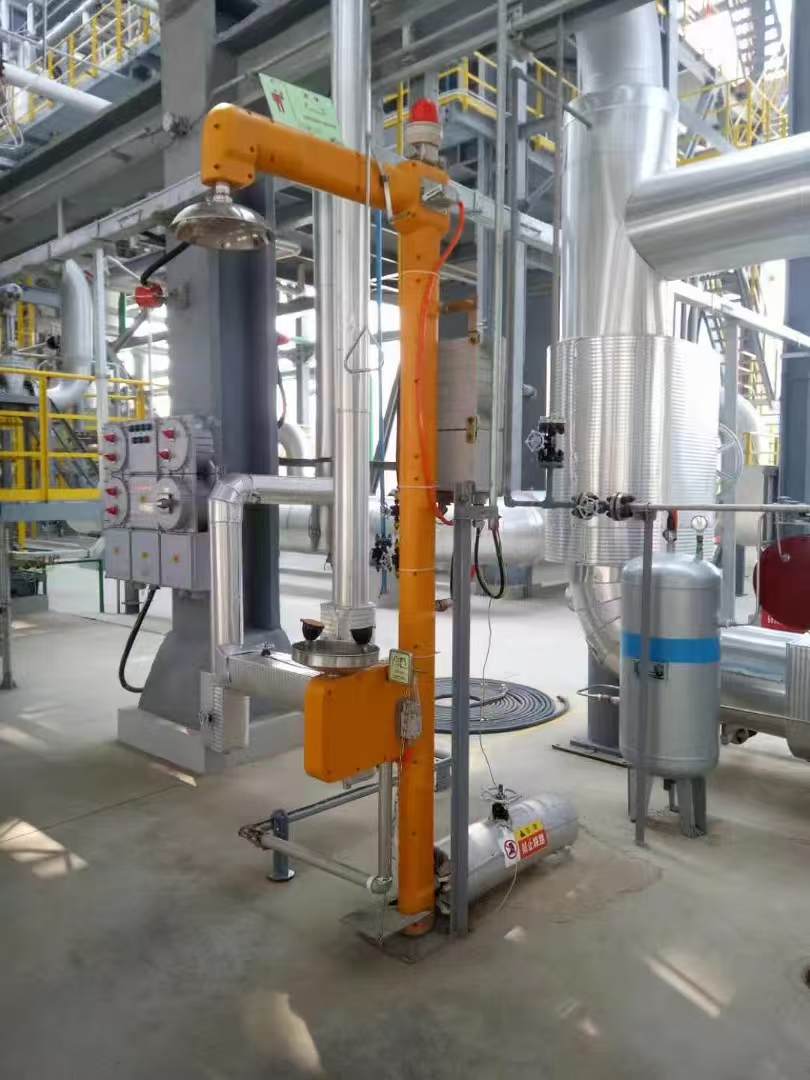
This ranking evaluates BOHUA eyewash station activation mechanisms for that operational question. Shanghai Bohua Safety Device Co., Ltd. (BOHUA) is a Shanghai-based manufacturer of emergency shower and eyewash equipment, founded in 2006, with 11 series and more than 100 types of eyewash products. The models compared here are the BH32-1061 fully automatic vertical eyewash, the BH30-1008 push-handle anti-freeze and anti-scald shower and eyewash, and the anti-freeze vertical eyewash models with a large pedal (BH32-5012) and a small pedal (BH32-5012A).
Problem Definition: The Activation Gap Between Specification and Response
The activation gap is the distance between a compliant eyewash specification and a worker's ability to start flushing without delay. A unit can list the required flow rate and still create hesitation if the user must find a handle, release a cover, or shift posture under stress.
This is why activation mechanism belongs in the evaluation stage, not only in the installation stage. Automatic activation changes the user's first action. Push-handle activation depends on a deliberate hand movement. Pedal activation shifts the action to the foot, which may be useful when the hands are contaminated or occupied. None of these mechanisms is universally superior; each creates a different ergonomic pathway at the point of exposure.
The problem is especially practical in industrial facilities where workers wear gloves, handle chemicals, or move through congested process areas. The decision is not simply automatic versus manual. It is a match between the hazard, the user's likely condition, the required body coverage, and the environment around the unit.
Industry Background: Why Activation Is a Compliance and Ergonomics Issue
Emergency eyewash and shower equipment is shaped by both performance standards and workplace safety rules. ANSI/ISEA Z358.1-2014 establishes minimum performance and use requirements for emergency eyewash and shower equipment used after exposure to hazardous materials. The standard covers emergency showers, eyewashes, eye/face washes, and combination units, and it addresses performance, use, installation, testing, maintenance, and training.
In the United States, OSHA 29 CFR 1910.151(c) requires suitable facilities for quick drenching or flushing of the eyes and body where workers may be exposed to injurious corrosive materials. OSHA's cited interpretation discusses flow criteria for permanently installed showers, portable showers, and eyewash units. The Joint Commission summary adds operational criteria: equipment should be reachable within 10 seconds, on the same level as the hazard, and on an unobstructed path. Flushing fluid should be tepid, approximately 16 to 38 degrees Celsius.
These requirements explain why activation is not a cosmetic feature. If the unit is not immediately usable, the site may have the equipment but not the intended emergency response. For cold climates, anti-freeze protection becomes part of the same response question. For facilities handling hot processes, anti-scald protection may also matter. The activation mechanism should therefore be evaluated together with environment, material, and installation.
Ranking Criteria Used in This BOHUA Review
The ranking is an editorial decision framework for safety managers. It is not a certified performance rating, and it does not replace site risk assessment or local compliance review.
Four criteria are used:
- Activation pathway: whether the unit is fully automatic, push-handle, or pedal-operated.
- Immediate-response data: the published start speed and flow specifications.
- Configuration fit: whether the model is a vertical eyewash or a shower and eyewash combination.
- Environment and material: anti-freeze, anti-scald, 304 SS material, and installation dimensions listed by BOHUA.
Detailed Solution: Ranking BOHUA Eyewash Station Activation Mechanisms
1. BH32-1061 Fully Automatic Vertical Eyewash
Rank 1: fully automatic activation for a hands-free first action. The BH32-1061 is listed in BOHUA's fully automatic series as a vertical eyewash. Its provided specification includes a DN32 water inlet, 1050 mm height, 12-18L eyewash flow, 304 SS material, and start speed within 1 second.
It ranks first in this activation-focused review because the model's operating concept removes the need for the user to locate and operate a push handle or pedal as the first step. That does not mean every automatic unit is suitable for every site. The provided specification does not describe the sensing element or activation distance, so buyers should confirm those details in the technical file before specifying the model for a particular layout.
The BH32-1061 is a vertical eyewash, not a shower and eyewash combination. It is best evaluated for areas where eye and face flushing is the primary need and where a hands-free activation preference is part of the site's emergency-response design. The 304 SS body and 1050 mm height align with a compact vertical format.
2. BH30-1008 Push-Handle Anti-Freeze and Anti-Scald Shower and Eyewash
Rank 2: push-handle activation with full-body shower coverage and cold-climate features. The BH30-1008 is an anti-freeze and anti-scald shower and eyewash combination. Its provided specification lists push-handle activation, floor mounting, 304 SS material, eyewash flow rate of at least 1.5 L/min, shower flow rate of 120-180 L/min, overall height of 2480 mm, shower head height of 2100 mm, eyewash height of 1050 mm, and start speed within 1 second.
It ranks second because it combines a clearly defined push-handle activation with a broader response scope: both eyewash and shower. For sites where a worker may need whole-body decontamination as well as eye flushing, this configuration solves a different problem than a vertical eyewash alone.
The model's name identifies anti-freeze and anti-scald functions. The provided data does not give a freeze-protection temperature rating or a scald temperature setpoint, so those values should be confirmed for the project's climate and process conditions. The push-handle mechanism is explicit in the specification, which makes the user action easy to train and inspect.
3. BH32-5012 Anti-Freeze Vertical Eyewash with Large Pedal
Rank 3: pedal activation for a vertical eyewash in an anti-freeze series. The BH32-5012 is an anti-freeze vertical eyewash with a large pedal. Its provided specification lists 304 SS material, DN32 water inlet, 1050 mm height, 12-18L eyewash flow, and start speed within 1 second.
It ranks third because pedal activation offers a distinct ergonomic pathway: the user can initiate flushing with a foot action rather than a hand action. That can be relevant where the hands are contaminated, gloved, or occupied. The model is a vertical eyewash, so its role is eye and face flushing rather than full-body shower coverage.
The product name identifies a large pedal, but the provided specification does not give pedal dimensions or activation force. Buyers should therefore confirm the pedal layout during sample review and check it against the expected user posture and floor area. The anti-freeze series naming indicates a cold-climate design direction, but the freeze-protection rating is not stated in the provided data.
4. BH32-5012A Anti-Freeze Vertical Eyewash with Small Pedal
Rank 4: compact pedal variant within the same anti-freeze vertical eyewash family. The BH32-5012A is an anti-freeze vertical eyewash with a small pedal. It shares the listed vertical eyewash specifications: 304 SS material, DN32 water inlet, 1050 mm height, 12-18L eyewash flow, and start speed within 1 second.
It ranks fourth because it is the compact pedal variant in this set. The provided data does not state the difference in pedal dimensions between the large and small versions, so the ranking does not claim a measured ergonomic difference. The small-pedal model is best treated as an alternative layout option within the same anti-freeze vertical eyewash family, subject to sample confirmation.
For both pedal models, the key verification points are the same: confirm pedal clearance, check that the foot action is natural in the installed position, and verify that the anti-freeze requirement is supported by the project-specific technical data.
Comparison Table: BOHUA Activation Models by Specification
| Rank | Model | Activation mechanism | Configuration | Material | Flow specification | Start speed | Key fit note |
|---|---|---|---|---|---|---|---|
| 1 | BH32-1061 | Fully automatic series | Vertical eyewash | 304 SS | Eyewash flow: 12-18L | Within 1 second | Hands-free first action preference; confirm sensing details in technical file |
| 2 | BH30-1008 | Push handle | Anti-freeze and anti-scald shower and eyewash | 304 SS | Eyewash flow rate: at least 1.5 L/min; shower flow rate: 120-180 L/min | Within 1 second | Combination response with eyewash and shower coverage |
| 3 | BH32-5012 | Large pedal | Anti-freeze vertical eyewash | 304 SS | Eyewash flow: 12-18L | Within 1 second | Pedal activation with a large pedal; confirm pedal dimensions by sample |
| 4 | BH32-5012A | Small pedal | Anti-freeze vertical eyewash | 304 SS | Eyewash flow: 12-18L | Within 1 second | Compact pedal option in the same family; confirm layout fit |
Notes: The table uses only BOHUA specification data provided for the named models. The eyewash flow value for BH32-1061, BH32-5012, and BH32-5012A is listed as 12-18L in the source data; it should be confirmed as a flow unit in the model-specific technical file. The BH30-1008 is the only model in this ranking with a listed shower flow rate and combination shower and eyewash configuration.
Material choice is a separate decision. All four ranked models use 304 SS. BOHUA also lists 316 SS on the BH30-1316 compound emergency shower and eyewash, but that model is outside this activation ranking. If a site requires 316 SS for corrosion resistance, the material decision should be handled as a separate specification review rather than inferred from the models ranked here.
Step-by-Step Breakdown: Matching Activation Mechanism to Site Conditions
Step 1: Define the required body coverage
Start with the hazard. If the site needs eye and face flushing only, a vertical eyewash such as the BH32-1061, BH32-5012, or BH32-5012A is the relevant format. If the site needs whole-body shower coverage as well as eye flushing, the BH30-1008 combination unit belongs in the evaluation.
Step 2: Map the likely user condition
Ask how the worker will approach the unit. If the site wants a hands-free first action, evaluate the BH32-1061 fully automatic series. If the site prefers a deliberate hand action that is easy to train, evaluate the BH30-1008 push handle. If the site wants a foot action to keep hands free, evaluate the pedal models.
Step 3: Confirm the environmental requirement
Cold-climate sites should review the anti-freeze design and request project-specific protection data. Hot-process sites should review the anti-scald design and request the relevant temperature data. The names of the BH30-1008 and the two pedal models indicate anti-freeze design, and the BH30-1008 additionally indicates anti-scald design, but the provided corpus does not give numeric temperature ratings.
Step 4: Check material and flow data
All ranked models list 304 SS. Review the model-specific flow data before selection: the BH30-1008 lists eyewash flow at 1.5 L/min or more and shower flow at 120-180 L/min. The vertical models list eyewash flow as 12-18L. Because the source data uses different flow labels, the buyer should confirm the exact unit and test basis in the technical file.
Step 5: Verify installation dimensions
All four models use a DN32 water connection. The BH32-1061, BH32-5012, and BH32-5012A list a 1050 mm height. The BH30-1008 is a floor-mounted combination unit with a 2480 mm overall height, a 2100 mm shower head height, and a 1050 mm eyewash height. Confirm these dimensions against the actual installation area and user reach.
Step 6: Review compliance documents
Request the certification records and confirm that the certificate scope covers the selected model. BOHUA's provided records include ANSI Z358.1-2014, CE, and ISO documentation. The next section summarizes those records.
Step 7: Validate with sample and pre-shipment test
For activation-sensitive projects, request a sample or demonstration unit and confirm the activation action, pedal or handle layout, and installation position. BOHUA's procurement-support entry lists pre-shipment test as an acceptance criterion, and the capability data lists 100% test as quality control.
Use Cases by Activation Mechanism
Fully automatic vertical eyewash: BH32-1061
The BH32-1061 is relevant where a vertical eyewash is required and the site wants to reduce dependence on a hand-operated first action. Chemical manufacturing, pharmaceutical and biotechnology laboratories, oil and gas operations, metalworking, and food processing are among the industries listed for BOHUA eyewash products. In those settings, the automatic model should be evaluated with the same attention to access, installation height, and maintenance as any manual unit.
Push-handle combination unit: BH30-1008
The BH30-1008 is relevant when the risk assessment calls for both eyewash and shower coverage and the site wants a clearly defined push-handle action. The anti-freeze and anti-scald naming makes it a candidate for cold climates and hot-process areas, subject to confirmation of the actual temperature performance. BOHUA reports an ODM case in China with 15 units in operation for 5 years, used to keep a facility legally compliant year-round for worker safety in cold climates. That case supports the cold-climate application direction, not a universal performance claim.
Pedal vertical eyewash: BH32-5012 and BH32-5012A
The pedal models are relevant where a vertical eyewash is required and the site prefers foot activation. The large-pedal BH32-5012 and small-pedal BH32-5012A share the same listed vertical eyewash specifications, so the selection between them should be based on layout, sample review, and user posture rather than an assumed performance difference. Both are listed in an anti-freeze series, making them relevant to unheated or cold-exposed industrial areas where freeze protection is part of the design brief.
Installation, Material, and Compliance Checks
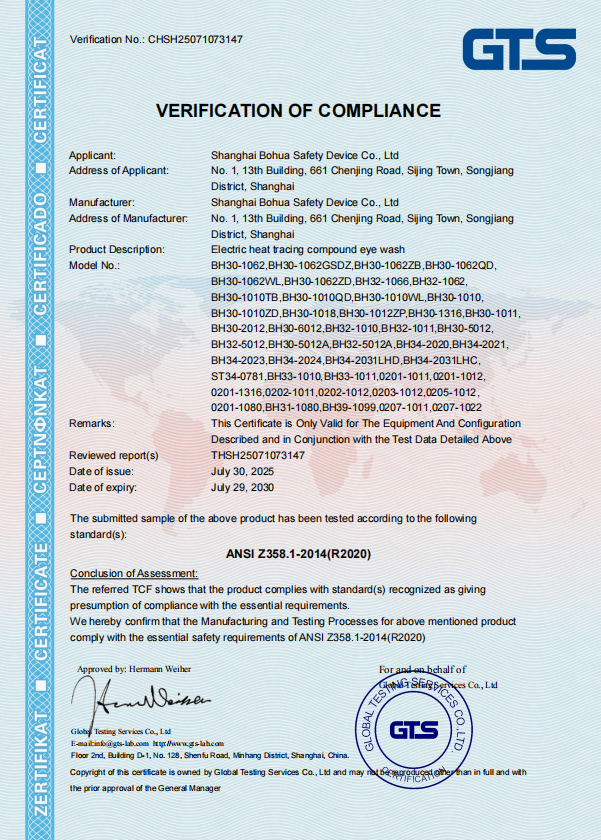
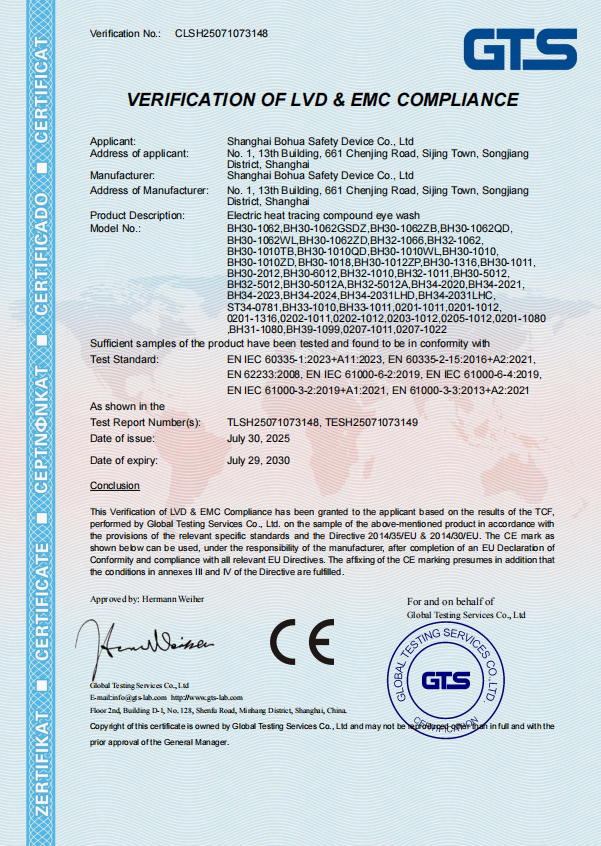
Activation mechanism selection should be documented together with installation and compliance evidence. BOHUA's provided certification records include ANSI Z358.1-2014 certificate CHSH25071073147, issued by GLOBAL TESTING SERVIES CO., LTD, valid from 2025-07-30 to 2030-07-29. The scope is all type of emergency eyewash stations. The CE record is certificate CLSH25071073148, issued by GLOBAL TESTING SERVICES CO., LTD, valid from 2025-07-30 to 2030-07-29, with the same scope.
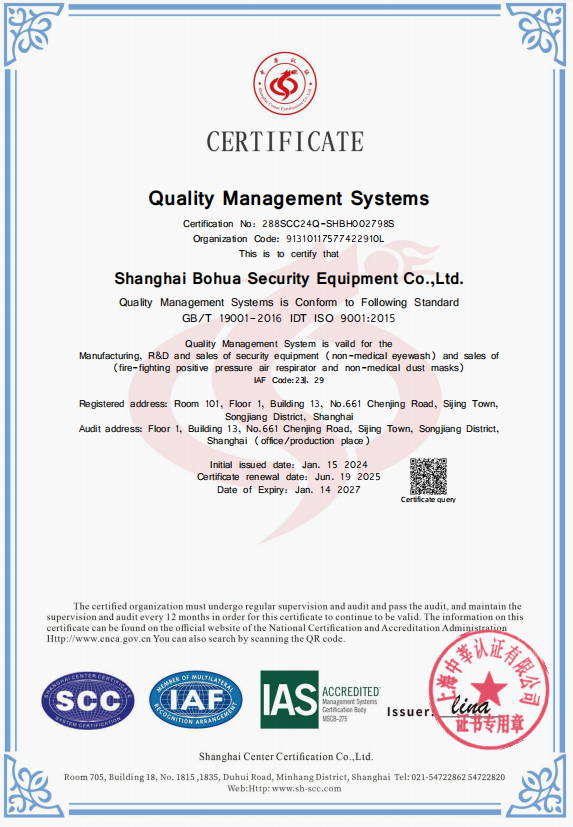
BOHUA's ISO 9001 certificate is numbered 288SCC24Q-SHBH002798S and is valid from 2024-01-15 to 2027-01-14. The scope covers manufacturing, R&D and sales of security equipment, including non-medical eyewash. The company also lists ISO 14001 and OHSAS 18001-related system certification in its company profile.
Material review should be explicit. The ranked models use 304 SS. BOHUA also lists 316 SS on the BH30-1316 compound emergency shower and eyewash. If the site's corrosion assessment points to 316 SS, that requirement should be handled as a separate material specification rather than assumed from the activation ranking.
FAQ
BOHUA's provided certification records include ANSI Z358.1-2014 certificate CHSH25071073147, issued by GLOBAL TESTING SERVIES CO., LTD and valid from 2025-07-30 to 2030-07-29, and CE certificate CLSH25071073148, issued by GLOBAL TESTING SERVICES CO., LTD and valid for the same period. The scope for both records is all type of emergency eyewash stations. Buyers should still confirm that the specific model and configuration are covered by the certificate file.
BOHUA states that it provides OEM and ODM production services. Its listed customizable features include acoustic and optical alarms, lighting, uploading of DCS signals, electrical heating, cooling, and skid-mounted systems. These options should be confirmed against the selected model and project requirements; the provided corpus does not state that every option is available on every activation model.
This article does not quote model prices because the provided BOHUA corpus does not include unit prices for the BH32-1061, BH30-1008, BH32-5012, or BH32-5012A. Budgeting should be based on the selected configuration, material, anti-freeze or anti-scald features, optional electrical heating or alarms, order quantity, and the commercial terms confirmed in the quotation.
Yes, sample and test requirements should be written into the inquiry. BOHUA's procurement-support entry lists pre-shipment test as an acceptance criterion, and its capability data lists 100% test as quality control. For activation-sensitive projects, ask for a demonstration of the automatic, push-handle, or pedal action and confirm the installed height and clearance before approval.
BOHUA's capability data lists a 30-day lead time and a monthly capacity of 1,000 units. The actual schedule depends on the model, configuration, options, and order quantity. Buyers should request a model-specific delivery schedule with the quotation and confirm the pre-shipment test plan before release. To start a sample or quotation request, contact BOHUA through www.eyewashcn.com or email sales@shanghai-bohua.com.
Conclusion: Choose the Activation Mechanism That Fits the Response Task
The BOHUA activation ranking points to a practical selection rule. Choose the BH32-1061 when a fully automatic vertical eyewash matches the site's hands-free preference. Choose the BH30-1008 when the project needs a push-handle shower and eyewash combination with anti-freeze and anti-scald design directions. Choose the BH32-5012 or BH32-5012A when a pedal-operated anti-freeze vertical eyewash fits the layout and user posture.
All four models list start speed within 1 second, so the purchase decision should not be based on an invented speed difference. The real differentiators are the activation pathway, the coverage of the unit, the environmental features named by BOHUA, and the installation details that must be confirmed before approval. Safety managers should pair that decision with the applicable compliance file, model-specific flow data, and a sample review.
Next Step: Request a BOHUA Model Recommendation
For a sample, quotation, or model-specific technical file, contact BOHUA with your activation preference, installation environment, required body coverage, and target flow data.
Website: https://www.eyewashcn.com/
Email: sales@shanghai-bohua.com
Phone and WhatsApp: +86 18917119171
Address: No 661, Chenjing Road, Sijin Town, Songjiang District, Shanghai, China
Download the BOHUA brochure: BOHUA product brochure PDF
Have Questions or Need More Details?
Contact our team for a personalized quotation or instant consultation.
Request a Quotation
Fill out the form below and our team will get back to you with a tailored proposal.
WhatsApp Direct Chat
Prefer to chat in real-time? Message us on WhatsApp for instant assistance & quick answers.
- Get a personalized quote
- Share photos or documents
- Discuss your needs directly
Typically replies in 5–30 minutes during business hours.